
Cryogenic MLI Applications for Aerospace and Cryogenic Hardware Programs
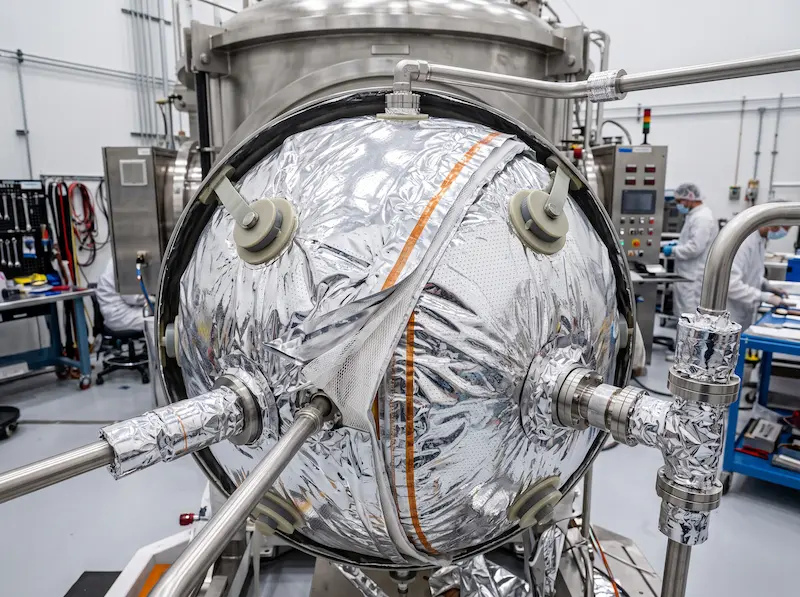
Thermal Heat Control
When Small Heat Leaks Matter to the Entire System
Cryogenic tanks, lines, cryostats, and related hardware operate with large temperature differences between the stored fluid or cold hardware and the surrounding environment. Uncontrolled radiative heat transfer can increase the thermal load and place additional demands on the system.
MLI can help reduce that heat transfer when it is designed and installed for the actual application. The challenge is that blanket performance can change when layers are compressed, penetrations are poorly handled, or installation around supports and interfaces creates unintended heat paths.
Vacuum Environment
Designed Around the Vacuum Environment and Real Hardware
Cryogenic MLI performance depends on more than reflective layer count. Layer arrangement, blanket density, seam placement, support penetrations, compression, venting strategy, material selection, and available vacuum environment each influence how insulation performs around cryogenic hardware under operational conditions.
AeroTemp reviews hardware geometry and operating requirements before developing the blanket approach ensuring MLI fits precisely around tanks, piping, instrumentation, supports, and hardware interfaces while remaining practical for fabrication and installation throughout the cryogenic assembly process.
- Cryogenic layer arrangement and density
- Hardware geometry review conducted
- Fabrication and installation practicality maintained

Cryogenic Challenges
Managing the Areas Where Cryogenic MLI Often Becomes Difficult
Large uninterrupted surfaces are usually not the hardest part of a cryogenic insulation system. Problems tend to appear around supports, valves, lines, sensors, brackets, feedthroughs, access areas, and transitions where blanket coverage has to work around other hardware.
AeroTemp considers those areas during development rather than leaving them for the installation team to solve later. Clear blanket boundaries, penetrations, overlaps, and interface details can help reduce avoidable gaps, compression, and fit issues while making the insulation easier to install and inspect.
What AeroTemp Considers During Cryogenic MLI Development
- Cryogenic tank, vessel, or system geometry
- Operating temperature requirements
- Vacuum conditions
- Required insulation coverage
- Supports and structural interfaces
- Tubing, lines, and feedthroughs
- Sensors and instrumentation
- Penetrations and access points
- Blanket seams and overlaps
- Layer arrangement
- Compression-sensitive areas
- Attachment methods
- Material requirements
- Cleanliness or contamination controls
- Installation and inspection access
- Testing requirements
Where cryogenic insulation forms part of a wider spacecraft thermal-control system, AeroTemp can coordinate the work with broader multilayer insulation requirements.
The goal is not to add the greatest possible number of layers. It is to develop an MLI configuration that fits the hardware, respects the operating environment, and can be installed without undermining the intended thermal design.
Frequently Asked Questions
What is cryogenic MLI used for?
Is cryogenic MLI the same as spacecraft MLI?
Why are supports and penetrations important in cryogenic MLI design?
Does adding more MLI layers always improve performance?
What happens after the cryogenic MLI design is defined?
- Reach out to us