
Custom MLI Blanket Design for Aerospace Hardware
Custom MLI blanket design for engineers who need insulation that fits real hardware, grounds correctly and vents safely. Share your model or drawings, and we’ll return a buildable design. Request a design review today.

Generic Blanket Limitations
Why Generic Blankets Fall Short
Standard blankets assume simple, uninterrupted shapes. Real hardware has brackets, harnesses, thruster mounts and instrument apertures, and every cutout becomes a seam or penetration where heat finds a way through.
Grounding, venting and fixation add further constraints, and they are often settled late, when changes cost the most. Designing them together early avoids rework during fit-checks and integration, and keeps thermal performance closer to what your thermal model predicted on paper.
Custom Design Package
What The Design Package Covers
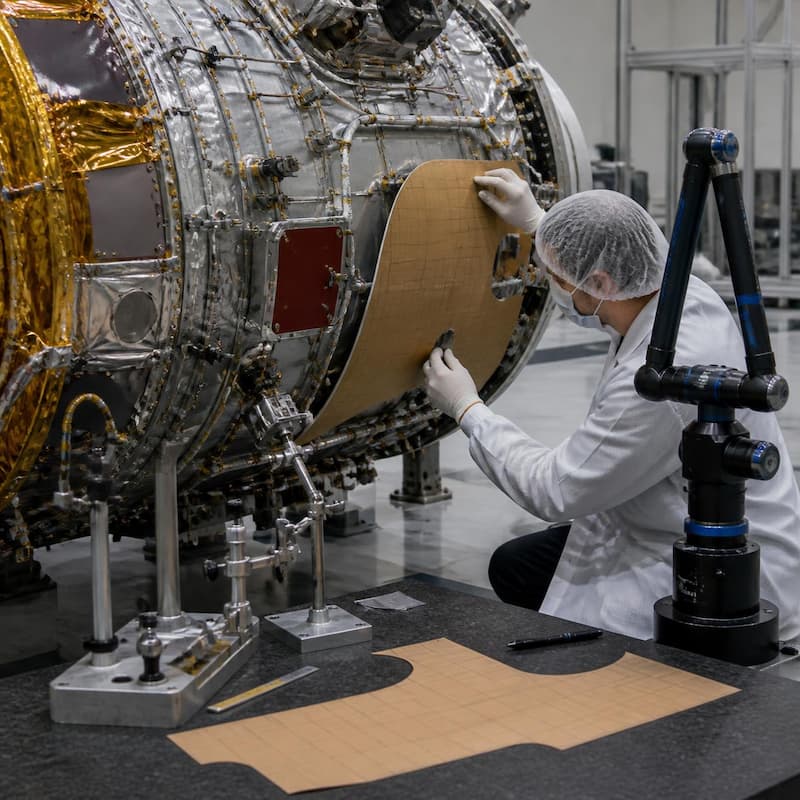
Each design starts from your 3D model, drawings or flight hardware, then turns into a flat pattern ready to cut and sew. The package is specific to your layup, temperature range and environment, whether that is low Earth orbit, a cryostat or a thermal vacuum chamber. Nothing is left as a note to figure out during installation, so your technicians know what goes where.
- Grounding and venting details, with installation notes
- Cut patterns, slits and fixation points mapped to your geometry
- Layup and materials matched to your thermal and environmental needs
Design Process Steps
What Happens After You Get In Touch
Send what you have, even if it is incomplete. A first reply confirms what is missing and whether the work looks like a design-to-fit or build-to-print job. A short call or email thread then clarifies temperature range, environment, grounding rules and delivery constraints. Nothing is committed until the scope and timeline are agreed, and prototype or fit-check options can be discussed early.
- Share your model, drawings or requirements
- Review scope, risks and design approach together
- Receive the design, then move to prototype or build
Frequently Asked Questions
Can you build from a design I've already completed?
Yes. If your 3D MLI design is finished, send it along and the work can be scoped as build-to-print. If it needs adjusting for grounding, venting or fixation, those changes can be flagged before anything is cut.
How well will the blanket actually insulate?
Expect some gap between prediction and reality. Effective emittance varies with workmanship, seams and penetrations, which is why design margins and test correlation matter. The design reduces avoidable losses, but it cannot promise a single exact figure.
Is custom design worth it for a CubeSat or a one-off instrument?
Often, but not always. Small platforms lose proportionally more heat at blanket edges, and in some cases coatings or a simpler layup are enough. An honest early assessment is part of the review.
What do you need to give me an estimate?
A 3D model or drawings, the temperature range, the operating environment, and any grounding or venting requirements. If something isn’t defined yet, say so and it can be worked through together.
How long will it take and what will it cost?
Both depend on size, geometry, layup, quantity and whether you want a prototype first. Complex shapes and fit-check templates add time. A realistic range is easier to give once your model has been reviewed.
- Reach out to us