
Heat and Plume Shields for Aerospace Hardware
When aerospace hardware sits near intense radiant heat or plume-related thermal exposure, AeroTemp develops custom shields around the actual environment, geometry, interfaces, clearances, and integration conditions.

Cleanroom Standards
When Nearby Heat Becomes a Hardware Risk
A component does not have to be the heat source to become a thermal concern. Hardware near thrusters, propulsion assemblies, or exhaust paths may receive radiant or plume-related heat that affects surrounding structures, instruments, wiring, and sensitive components.
AeroTemp identifies exposure sources and protection requirements before developing the shield approach ensuring thermal management is addressed while respecting access, interfaces, clearances, attachments, and technician working requirements around the hardware.
- Radiant and plume heat exposure analysis
- Protection requirement identification first
- Interface and clearance compatibility
- Technician access maintained throughout
CAD Development
Designed Around The Exposure, Not Just The Temperature
A useful heat or plume shield depends on more than a maximum temperature value. Distance from the source, direction of exposure, duration, neighboring hardware, available space, mounting conditions, and the surfaces that must remain accessible can all change the design approach.
AeroTemp reviews available CAD data, drawings, thermal requirements, hardware geometry, and integration constraints before defining the shield configuration. This helps the design respond to the real assembly rather than treating the thermal problem as an isolated number on a specification sheet.
Cleanroom Standards
Protecting the Right Area Without Creating a New Integration Problem
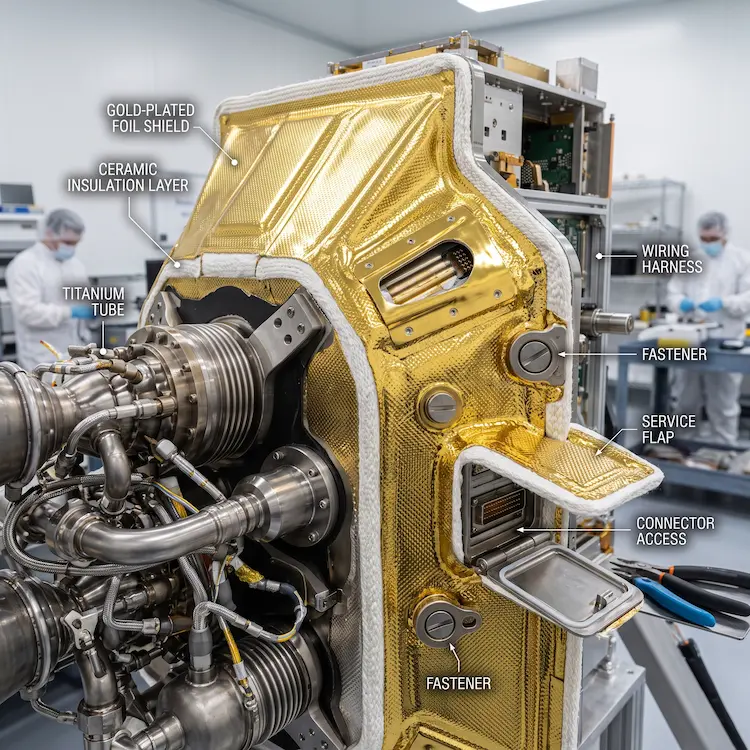
Space around propulsion and high-heat hardware is often limited. Brackets, tubing, harnesses, sensors, fasteners, connectors, and nearby structures may leave little room for an additional protective layer. A shield that controls exposure but blocks access or interferes with surrounding hardware can create a different problem for the program.
AeroTemp considers those conflicts during development. Boundaries, interfaces, openings, attachment areas, and clearances can be worked around the actual geometry so the shield remains practical to fabricate, inspect, install, and support during integration.
What AeroTemp Reviews for Heat and Plume Shield Development
Heat and plume protection is developed around actual hardware exposure and operational conditions not generic shield patterns. Depending on program requirements, AeroTemp reviews:
- Heat and plume source location
- Direction and expected thermal exposure
- Hardware and components requiring protection
- Nearby sensitive instruments and wiring
- Available installation and attachment space
- Curved or irregular surface geometry
- Brackets, tubing, harnesses, and sensors
- Required openings and access points
- Attachment locations and keep-out zones
- Environmental and cleanliness requirements
Where the shield interfaces with other thermal-control hardware, AeroTemp can coordinate the requirement with broader multilayer insulation development.
Frequently Asked Questions
What is a heat or plume shield used for in aerospace hardware?
How is a plume shield different from a standard insulation blanket?
Can AeroTemp design shields around tight or complex hardware?
What information is most important at the beginning of a project?
What happens after the shield design is established?
- Reach out to us